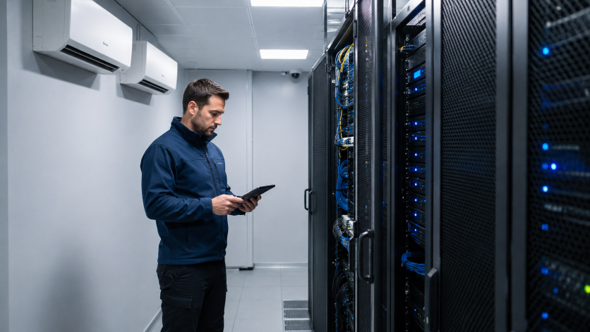
AC maintenance, data room cooling, commercial air conditioning maintenance
Server rooms and communications rooms can contain some of the most business-critical equipment in a building. Servers, network switches, UPS systems and other IT equipment generate heat continuously. Unlike a normal office, that heat load can remain present overnight, at weekends and throughout winter. A failure of the cooling system can therefore become much more than a comfort issue. If temperatures rise beyond the operating limits of the IT equipment, businesses can face equipment shutdowns, reduced component life and potentially expensive disruption. A well-designed server-room cooling system should therefore be based around heat load, airflow, resilience and maintainability, rather than simply selecting an air-conditioning unit based on the size of the room.
1. Size the air conditioning from the actual heat load
One of the most important parts of a server-room design is establishing how much heat the equipment actually produces. In many IT rooms, almost all of the electrical power consumed by servers and associated equipment eventually becomes heat that must be removed by the cooling system. The design should consider:
- Servers and network equipment
- UPS systems
- Lighting
- Other electrical equipment
- Solar gain where applicable
- Heat entering through surrounding rooms
- Future IT expansion
The floor area alone is not a reliable method of sizing server-room cooling. Significant oversizing should also be avoided. Depending on the equipment and control strategy, excessive capacity can result in poor control, unnecessary cycling and inefficient airflow distribution. The system should instead be selected against the calculated sensible heat load and the manufacturer’s operating envelope.
2. Measure temperatures where the servers actually take in air
The room thermostat does not always tell you what the IT equipment is experiencing. Server racks normally take cooling air in at the front and discharge warmer air at the rear. If hot discharge air recirculates back towards the rack inlet, temperatures at the top of the rack can be considerably higher than the general room temperature. Temperature sensors should therefore be considered at representative equipment air inlets, particularly where racks contain a high heat density. ASHRAE guidance widely used within the data-centre industry recommends an inlet dry-bulb temperature range of 18°C to 27°C for relevant equipment classes, although this is guidance rather than a UK statutory temperature limit. The equipment manufacturer’s own environmental limits should always take priority. ASHRAE Handbook
3. Manage hot and cold air properly
Simply producing more cold air does not necessarily solve a server-room cooling problem. Good airflow management is often just as important as cooling capacity. Typical problems include:
- Cold air bypassing the equipment
- Hot exhaust air recirculating to rack inlets
- Obstructed supply grilles
- Poor return-air positioning
- Gaps within racks allowing unwanted air movement
- Equipment installed too close to walls or other heat sources
For larger installations, hot-aisle and cold-aisle arrangements or containment systems may improve cooling performance. For smaller comms rooms, even relatively simple changes to supply and return-air positioning can make a substantial difference.
4. Consider what happens if one cooling system fails
A single air-conditioning system creates a single point of failure. Whether redundancy is justified depends on the importance of the IT equipment and the consequence of losing cooling. For a small non-critical communications cupboard, one correctly selected system may be appropriate. For a server room where a shutdown could interrupt business operations, a more resilient arrangement may use two systems. Possible arrangements include:
- Duty and standby
- Lead and lag
- Automatic changeover
- Alternating operation
- Two units sharing the normal load
The appropriate level of resilience should be based on business risk rather than assuming every server room requires a particular configuration. For larger data-centre environments, the current BS EN 50600-3-1:2026 standard addresses management and operational processes including resilience, availability, risk management, capacity planning and energy efficiency. BSI Knowledge
5. Make sure the equipment can cool during cold weather
Server rooms can require cooling throughout the year. That means the air-conditioning system may need to operate in cooling mode when outdoor temperatures are very low. Not every comfort-cooling system has the same low-ambient cooling capability. When selecting equipment, the designer should confirm:
- Manufacturer operating temperature range
- Low-ambient cooling capability
- Any required control accessories
- Outdoor-unit location
- Exposure to wind and weather
This should be checked against the manufacturer’s technical data rather than assumed.
6. Pay particular attention to condensate drainage
Server-room air-conditioning installations often operate continuously. A condensate drain problem can therefore be particularly disruptive. Where possible, gravity drainage is generally preferable because it removes one potential mechanical failure point. Where a condensate pump is necessary, it should be installed so it can be inspected and maintained. High-level alarm or shutdown arrangements may also be appropriate where water leakage could damage IT equipment.
7. Do not wait for a cooling failure before servicing the equipment
Server-room air conditioning should be treated as critical plant where the business depends on it. Preventative maintenance can identify developing issues such as:
- Dirty filters
- Blocked heat exchangers
- Fan deterioration
- Condensate drainage problems
- Electrical defects
- Fault codes
- Refrigerant-system problems
- Poor airflow
- Unusual vibration or noise
Maintenance frequency should reflect the environment, operating hours, manufacturer requirements and the consequence of failure. A system running 24 hours a day in a dusty environment may require more attention than an ordinary office air-conditioning system.
UK compliance considerations
Server-room air conditioning is subject to the same UK regulatory requirements that apply to other refrigeration and air-conditioning equipment.
F-Gas qualifications
Where equipment contains fluorinated refrigerant, anyone carrying out installation, servicing, maintenance, refrigerant recovery or leak checking must hold the appropriate qualification. Companies carrying out this work on stationary air-conditioning equipment for other organisations must also hold the appropriate company certification. GOV.UK
Refrigerant leak checks
Some stationary air-conditioning systems containing F-gases are subject to mandatory refrigerant leak inspections depending on the type and quantity of refrigerant contained within the equipment. Higher-charge systems may require more frequent checks, while automatic leak detection can alter the permitted inspection interval. Where a leak is identified, the regulations require it to be repaired and subsequently checked. GOV.UK
Air-conditioning energy inspections
In England and Wales, air-conditioning systems with an effective rated output of more than 12 kW must normally be inspected by an accredited energy assessor at intervals of no more than five years. This can include several smaller units where their combined effective rated output exceeds 12 kW and they are considered part of the same system under single control. GOV.UK These inspections are separate from normal servicing and maintenance. Dedicated process cooling can fall within the regulations, although the government’s published guidance is principally aimed at building air-conditioning systems, so the specific installation should be reviewed where necessary. GOV.UK
Frequently asked questions
What temperature should a server room be?
There is no single UK statutory server-room temperature. ASHRAE guidance commonly used in the data-centre industry recommends an equipment inlet temperature of approximately 18°C to 27°C for relevant equipment classes. The important measurement is the temperature of the air entering the IT equipment, and the manufacturer’s own limits should always be followed. ASHRAE Handbook
Does a server room need air conditioning in winter?
Often, yes. IT equipment produces heat throughout the year, so a server room can require mechanical cooling even when outdoor temperatures are low.
Should server rooms have two air-conditioning units?
Not necessarily. Redundancy should be determined by the business risk. Where a cooling failure could shut down important IT services, a duty/standby or similar arrangement may be justified.
Can I use ordinary office air conditioning for a server room?
Potentially, but the equipment needs to be suitable for the actual heat load, continuous operating requirements and expected outdoor conditions. Server rooms should not simply be treated as another office.
How often should server-room air conditioning be serviced?
There is no universal interval suitable for every installation. Maintenance should reflect operating hours, equipment type, environmental conditions, manufacturer recommendations and the consequence of failure.
Do server-room systems need an air-conditioning inspection?
In England and Wales, systems with a combined effective rated output above 12 kW may fall within the statutory air-conditioning inspection requirements. This inspection is different from a routine maintenance visit. GOV.UK
Warning signs your server-room cooling needs attention
Arrange an inspection if you notice:
- Rising rack inlet temperatures
- One part of the room becoming much hotter than another
- Air-conditioning units running continuously without controlling temperature
- Repeated fault codes
- Water leakage
- Unusual noises
- Weak airflow
- Unexpected shutdowns
- A noticeable increase in electricity consumption
- One unit carrying the entire load because another has failed
These symptoms do not automatically mean the system needs replacing. A proper investigation should establish whether the cause is equipment condition, controls, airflow, increased IT load or system design.
Planning or upgrading server-room air conditioning?
Aircon Services can assess server rooms, communications rooms and other critical cooling applications and recommend an appropriate solution based on the actual cooling load and resilience requirements. This can include:
- Cooling-load assessment
- Equipment selection
- Split and multi-split systems
- Redundant cooling arrangements
- Replacement systems
- Airflow improvements
- Planned maintenance
- Fault diagnosis
Commercial air-conditioning systems Air-conditioning servicing Contact Aircon Services