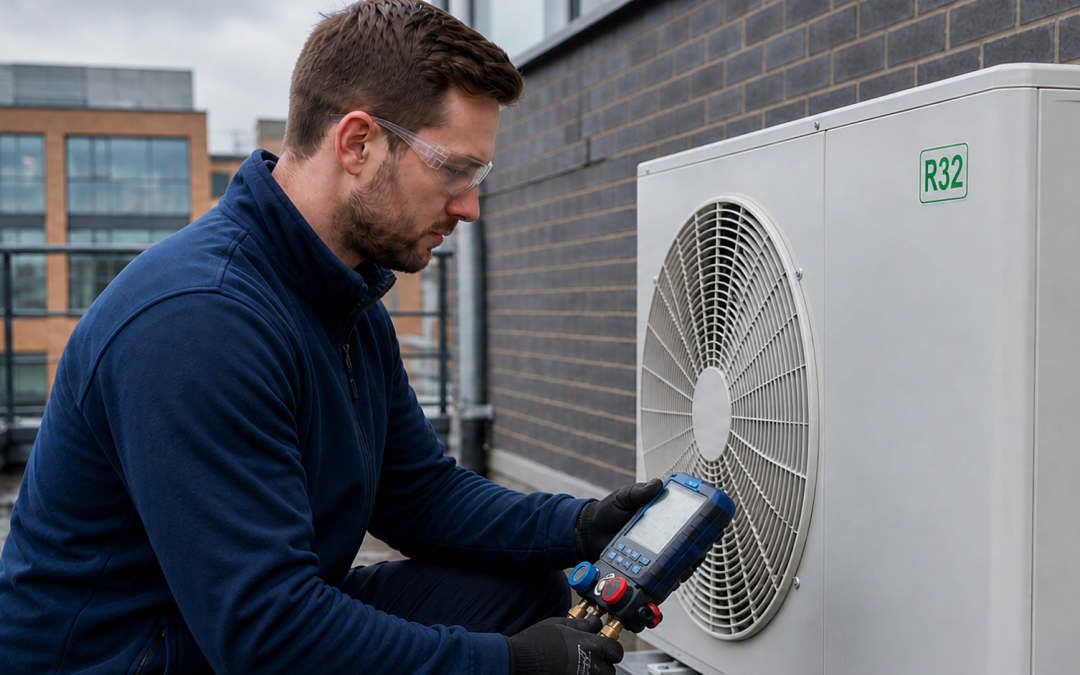
If you have been told that R32 air conditioning is being banned, the short answer is no: R32 itself is not banned in Great Britain. The confusion comes from a product restriction that took effect in 2025 for certain small single-split systems using refrigerants with a global warming potential (GWP) of 750 or more.
R32 has a GWP of 675, so it sits below that threshold. On 27 August 2026, the Government updated its guidance to make three exemptions clearer. That update is useful, but it does not turn ordinary R32 systems into prohibited equipment. Here is what the rules mean for a business choosing, operating or maintaining commercial air conditioning in 2026.
What does the 2025 F-gas restriction actually cover?
The restriction concerns placing particular new products on the market in Great Britain. It applies to single-split air-conditioning systems containing less than 3 kg of an F-gas with a GWP above 750.
That wording matters. It is not a blanket ban on all split systems, and it is not an instruction to remove compliant equipment already installed. R410A has a GWP above the threshold, whereas R32 is below it, which is one reason R32 became common in newer split systems.
- The 750 threshold is about the refrigerant’s GWP, not the cooling capacity printed on the unit.
- The restriction applies to a defined category of new single-split equipment containing less than 3 kg of refrigerant.
- Different rules and design considerations can apply to larger splits, multisplits, VRF systems, chillers and heat pumps.
What changed on 27 August 2026?
The Government guidance now lists three specific exemptions alongside the small single-split restriction: larger air-conditioning or heat-pump systems such as chillers or larger splits; stationary single splits used solely to cool products, which are treated as refrigeration equipment; and air-to-water single-split systems. It also lists single-split systems fitted to maritime craft.
For most offices, shops and homes considering a normal comfort-cooling system, the practical message remains simple: equipment selection should be based on the current product range, application, refrigerant, safety requirements and long-term support – not on a headline claiming that every F-gas system is banned.
Can an existing R32 air-conditioning system still be used and serviced?
Yes. A correctly installed R32 system can continue to be operated and maintained. R32 is mildly flammable (A2L), so refrigerant work needs the correct competence, tools and procedures. Anyone carrying out work that involves handling F-gas must hold the appropriate personal qualification; businesses undertaking relevant stationary equipment work also need company certification.
An air-conditioning service is not simply a refrigerant top-up. A competent visit should investigate the reason for any loss, check system condition, clean heat exchangers and filters where required, test drains and controls, record findings and only carry out refrigerant work when it is justified.
Should you replace an older R410A system now?
Not automatically. A functioning system may still deliver useful service life. Replacement becomes more compelling when breakdowns are frequent, parts are becoming difficult to obtain, capacity no longer matches the building, energy performance is poor, or refurbishment creates an opportunity for a better design.
The sensible starting point is a condition survey. It should record the indoor and outdoor models, refrigerant, age, pipework condition, electrical supply, controls, maintenance history, criticality and likely replacement route. That gives you an evidence-based plan instead of an emergency decision during a failure.
- Keep the asset register and service records up to date.
- Use an appropriately certified air-conditioning contractor.
- Ask for the proposed refrigerant and long-term support position when buying new equipment.
- Plan replacement around business risk, condition and efficiency rather than refrigerant rumours.
Choosing new air conditioning in 2026
Refrigerant is only one part of a good system choice. The design should also address room heat gains, simultaneous use, fresh-air requirements, noise, drainage, maintenance access, controls and the location of outdoor equipment. A lower-GWP product still performs poorly if it is incorrectly sized or difficult to maintain.
Aircon Services designs, installs and maintains commercial systems across Oxfordshire, Buckinghamshire, London and the surrounding areas. We can review an existing asset list or survey a proposed replacement so the recommendation fits the building and the current rules.
Frequently asked questions
Is R32 refrigerant banned in the UK?
No. R32 has a GWP of 675 and is below the 750 threshold in the 2025 restriction for defined small single-split systems.
Is R410A air conditioning illegal to use?
No blanket rule makes an existing R410A system illegal to operate. The 2025 measure restricts placing certain new small single-split products on the market. Existing equipment should be assessed and maintained correctly.
Can any engineer service R32 air conditioning?
Refrigerant work must be carried out by someone with the appropriate F-gas qualification, using procedures and equipment suitable for an A2L refrigerant.
Do I need to replace my air conditioning because of F-gas rules?
Not solely because it contains an older refrigerant. Condition, reliability, repairability, energy use and business risk should drive the decision.
What refrigerant should I choose for a new system?
There is no one answer for every application. Ask the designer to explain the proposed refrigerant, safety considerations, product availability, efficiency and likely support life.
Need advice on an existing or proposed system? Aircon Services can review your equipment, refrigerant, condition and replacement options.
Call 0800 998 9135 or email enquiries@aircon-services.co.uk to arrange a system survey.