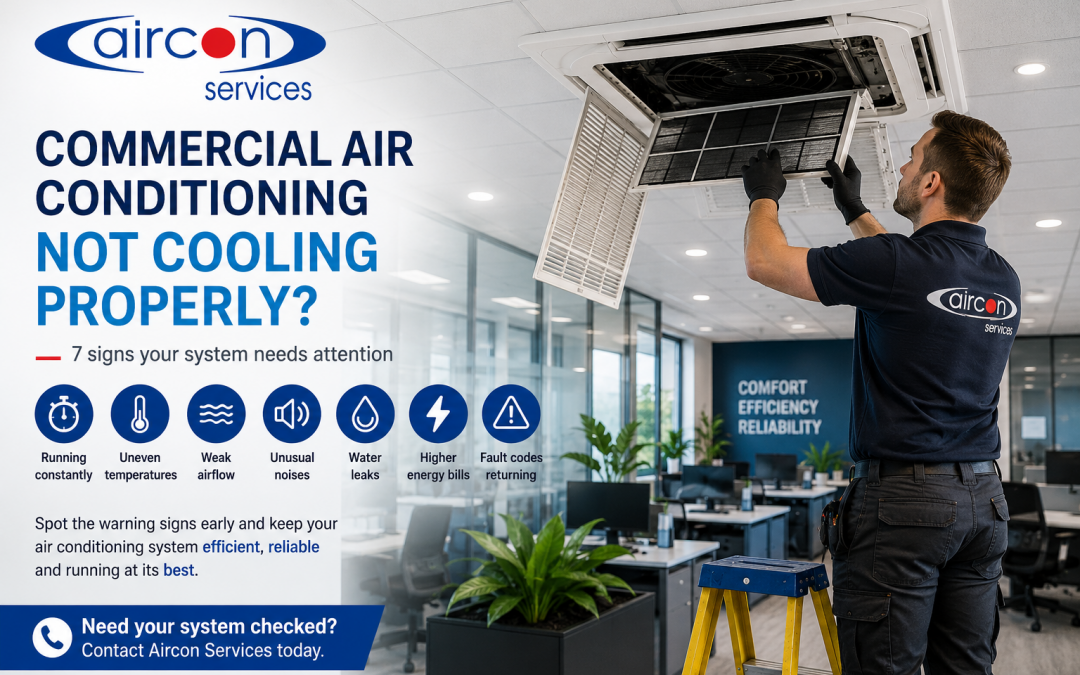
Commercial Air Conditioning Not Cooling Properly? 7 Signs Your System Needs Attention
When commercial air conditioning is working correctly, most people barely notice it. The building simply remains comfortable.
When performance starts to fall away, however, the first signs are not always a complete breakdown.
Longer running times, warmer rooms, unusual noises or one area of the building that never quite reaches temperature can all indicate that a system needs attention.
For businesses across Oxfordshire, Buckinghamshire, London and the surrounding areas, dealing with these warning signs early can help avoid a much more disruptive failure later.
1. The building takes much longer to cool
If your air conditioning previously brought the building down to temperature quickly but now runs continuously, something may have changed.
Common causes include dirty filters, restricted coils, poor airflow, control problems or faults elsewhere in the refrigeration system.
A system that runs for longer than necessary can also increase electricity consumption.
2. Some rooms are comfortable while others are too warm
Uneven temperatures are particularly common in offices, schools and multi-zone commercial buildings.
The problem may be as simple as a blocked filter or incorrect controller setting, but it can also indicate a problem with an indoor unit, branch control system, sensor or refrigerant circuit.
Rather than simply reducing the thermostat further, it is normally better to identify why the affected area is underperforming.
3. Airflow from the indoor units feels weak
Reduced airflow can make a correctly sized air-conditioning system feel dramatically less effective.
Possible causes include:
- Dirty filters
- Blocked heat exchangers
- Fan motor problems
- Damaged or restricted ductwork
- Incorrect fan settings
- Obstructed grilles
Regular maintenance is designed to identify many of these issues before they turn into breakdowns.
4. The system is making unusual noises
Air-conditioning equipment should not suddenly become noticeably louder.
Rattling, grinding, humming or intermittent mechanical noises can indicate loose components, fan problems or other developing faults.
Early investigation is particularly important where air conditioning serves critical areas such as server rooms, communications rooms or process areas.
5. Your electricity use has increased
An inefficient air-conditioning system can continue to provide some cooling while using considerably more energy than it should.
Dirty coils, restricted airflow and incorrect operation can all force equipment to work harder.
Preventative maintenance is therefore not only about avoiding breakdowns. It can also help keep the system operating efficiently.
6. The system is leaking water
Water appearing around an indoor air-conditioning unit should always be investigated.
A blocked condensate drain, failed pump or damaged drain line can allow water to escape into ceilings, walls or occupied areas.
Ignoring a small leak can turn a relatively straightforward repair into damage to decorations, ceilings or electrical equipment.
7. Fault codes keep returning
Resetting a system can occasionally clear a temporary problem, but repeatedly resetting the same fault is not a repair.
Modern VRF, VRV and split air-conditioning systems use fault codes to help engineers identify what is happening within the equipment.
If a fault repeatedly returns, the underlying cause should be diagnosed properly.
Why preventative commercial AC maintenance matters
Regular servicing can help identify developing problems before they result in equipment failure.
A good maintenance visit should consider the condition and operation of the whole system, including filters, heat exchangers, fans, condensate drains, electrical components, controls and refrigeration performance.
For businesses that rely heavily on air conditioning, planned maintenance can also make repairs easier to schedule rather than having to react to an unexpected breakdown during hot weather.
Frequently Asked Questions
How often should commercial air conditioning be serviced?
The correct frequency depends on the type of equipment, how heavily it is used and the environment in which it operates. Heavily used commercial systems will normally require more attention than lightly used equipment.
Why is my commercial AC running but not cooling?
Possible causes include restricted airflow, dirty heat exchangers, control problems, sensor faults or refrigeration-system issues. A proper diagnosis is preferable to simply lowering the temperature setting.
Can dirty filters increase air-conditioning running costs?
Yes. Restricted airflow can reduce performance and make the system work harder to achieve the required temperature.
Should server-room air conditioning be maintained more frequently?
Critical cooling generally deserves a higher level of attention because a failure can affect IT equipment and business continuity.
Is a commercial air-conditioning inspection the same as a service?
No. Statutory energy inspections and routine equipment servicing serve different purposes. Businesses should make sure they understand which requirements apply to their installation.
Need your commercial air conditioning checked?
If your air conditioning is struggling, producing faults or simply has not been serviced recently, Aircon Services can inspect the equipment and recommend the most appropriate next step.