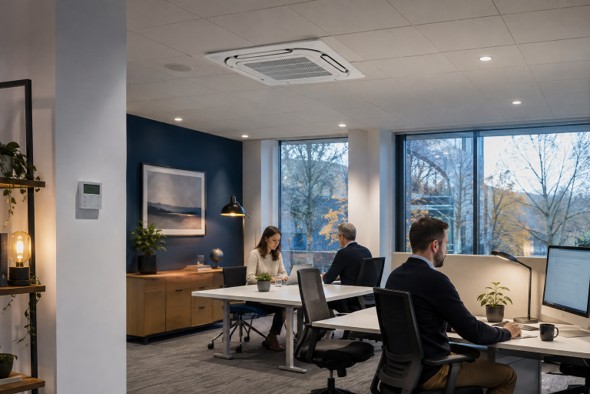
Many commercial air-conditioning systems installed in offices, shops, hotels and other workplaces are actually reversible air-to-air heat pumps. That means the same equipment used to cool a building during summer can often operate in reverse and provide efficient space heating during winter. Instead of generating heat directly, an air-to-air heat pump transfers heat from the outdoor air into the building. Because it moves heat rather than producing it through direct electric resistance, it can deliver several units of useful heat for each unit of electricity it consumes. For some businesses, this means an air-conditioning system that is already installed primarily for cooling could potentially reduce how much the main boiler or other heating system needs to operate. However, that does not mean every commercial building should simply put the air conditioning into heating mode and switch off the boiler. Heating capacity, outdoor temperature, building heat loss, zoning, controls, airflow, electricity supply, operating costs and the way the building is occupied all need to be considered. A relatively simple review before the heating season can establish where air-conditioning heating can be used effectively and where a hybrid approach remains more appropriate.
How Does Air Conditioning Provide Heating?
A reversible air-conditioning system is essentially an air-to-air heat pump. During cooling, the refrigerant system absorbs heat from inside the building and rejects it outdoors. During heating, the refrigeration cycle reverses. Heat is absorbed from the outdoor air and transferred through the refrigerant circuit to the indoor units, which then deliver warm air into the occupied space. There can still be usable heat available in outdoor air when the outside temperature is very low, although the heating capacity and efficiency of a particular system depend on the equipment and operating conditions. Manufacturers therefore publish heating performance at defined outdoor temperatures, and these figures should be checked when assessing whether an existing system can meet a building’s winter heating requirement.
Why Can Heat-Pump Air Conditioning Be Efficient?
The efficiency of a heat pump is commonly expressed using Coefficient of Performance (COP) and Seasonal Coefficient of Performance (SCOP). A COP of 3, for example, means that under the specified operating conditions the system delivers approximately 3 kWh of heat for every 1 kWh of electricity consumed. SCOP provides a broader indication of performance over a heating season rather than at one particular test condition. This is fundamentally different from direct electric resistance heating, where approximately one unit of electrical energy produces one unit of heat. However, a higher efficiency does not automatically mean a lower energy bill than gas heating. The comparison depends on:
- The system’s actual seasonal efficiency
- Electricity tariffs
- Gas or other fuel tariffs
- Boiler efficiency
- Building heat loss
- Operating hours
- Control strategy
- Maintenance condition
For an accurate comparison, businesses should consider the cost of each delivered kWh of useful heat, rather than simply comparing the price of gas with the price of electricity.
Where Does Air-Conditioning Heating Work Particularly Well?
Air-to-air heat pumps can be particularly effective in commercial buildings with individual rooms or zones that do not all need heating at the same time. Typical applications include:
- Offices
- Shops and retail units
- Meeting rooms
- Reception areas
- Restaurants
- Hotels
- Clinics
- Classrooms
- Small warehouses and workshops
- Other intermittently occupied commercial areas
Individual indoor units can heat the areas that are actually occupied instead of relying on a central heating system to warm the whole building. This can be particularly useful during autumn and spring, when only limited heating may be required and running a large central boiler plant may not always be the most appropriate solution.
Can Existing Air Conditioning Reduce Boiler Use?
Potentially, yes. If a building already has suitable reversible air-conditioning systems, they may be able to provide a significant proportion of the building’s space heating. For example, a commercial building may choose to use air-conditioning heat pumps:
- During relatively mild weather
- During morning warm-up
- In individually occupied rooms
- In areas requiring different temperatures
- Outside the main boiler operating schedule
- In parts of a building that need heating while other areas are empty
The boiler or other heating plant can then remain available for areas that are not served by air conditioning or when the heat demand exceeds the available heat-pump capacity. This type of hybrid operating strategy can sometimes make better use of equipment that has already been installed.
Five Checks Before Relying on Air Conditioning for Winter Heating
1. Check the System’s Heating Capacity
Do not assume that the cooling capacity shown on an asset list tells you everything you need to know about heating performance. Confirm:
- Outdoor-unit model numbers
- Indoor-unit models
- Nominal heating capacity
- Heating capacity at lower outdoor temperatures
- Manufacturer operating limits
- Connected indoor-unit capacity
The available heating capacity should then be compared with the heat loss of the areas the system is expected to serve. Modern heat pumps can operate at very low outdoor temperatures, but operating range and capacity vary considerably between products.
2. Check Airflow and Unit Location
Producing enough heat at the indoor unit does not automatically mean occupants will be comfortable. Air distribution is important. Check:
- Discharge direction
- Fan speed
- Indoor-unit position
- Ceiling height
- Furniture or partitions obstructing airflow
- Whether warm air reaches the occupied zone
High-level wall-mounted and cassette units may require different discharge settings in heating mode compared with cooling. Poor air distribution can result in temperature differences within the room even when the controller indicates that the set point has been reached.
3. Review the Controls and Zoning
Controls are one of the most important parts of an efficient heating strategy. Check:
- Time schedules
- Heating set points
- Local controllers
- Centralised controllers
- Building Management System settings
- Occupancy schedules
- Whether unused areas are being heated
- Whether separate heating systems are competing with each other
For example, a radiator thermostat attempting to heat a room while an air-conditioning system is trying to cool it wastes energy and can result in both systems running unnecessarily.
Can VRF Systems Heat and Cool at the Same Time?
It depends on the type of VRF or VRV system installed. A conventional heat-pump VRF system will generally operate the connected system in either heating or cooling mode. A heat-recovery VRF system is specifically designed to allow different indoor zones to heat and cool simultaneously. This can be particularly useful in larger commercial buildings where one side of the building may require heating while another requires cooling because of solar gain, occupancy or equipment loads. Heat-recovery systems can also transfer recovered heat between areas of the building rather than simply rejecting all of it outdoors. Identifying which type of system is installed is therefore important before developing a winter operating strategy.
4. Allow for Defrost Operation
During heating operation, the outdoor heat exchanger becomes cold. In cold and damp weather, frost can form on the outdoor coil. The system will therefore periodically enter a defrost cycle to remove the ice. This is normal heat-pump operation. During defrost, heating output may temporarily reduce or stop depending on the equipment design. The system therefore needs to be correctly selected for the building rather than sized solely from its nominal heating figure.
5. Service the System Before Winter
Equipment that has worked hard throughout the cooling season should be checked before relying on it for winter heating. Maintenance should include, where appropriate:
- Cleaning or checking indoor filters
- Inspecting indoor heat exchangers
- Inspecting outdoor coils
- Checking fans and motors
- Checking controllers and sensors
- Checking refrigerant operation
- Inspecting electrical components
- Checking fault histories
- Checking condensate systems
- Ensuring outdoor units are unobstructed
- Checking outdoor-unit drainage for heating and defrost operation
Regular servicing also helps maintain system efficiency and reliability.
What Temperature Should an Office Be Heated To?
There is no single temperature that will be suitable for every workplace. For many offices, a heating set point of around 19°C can provide a sensible energy-efficient starting point, although the correct temperature depends on occupancy, activity levels, building conditions and occupant comfort. It is also important to avoid unnecessarily high heating set points. Setting an air-conditioning controller to 28°C will not normally make the room heat up faster than using an appropriate set point. It simply tells the system to continue heating until a much higher room temperature is reached. A consistent set point across neighbouring zones can also help prevent systems from fighting against each other.
Can Solar Panels Help?
Yes. Where a commercial property has photovoltaic panels, some electricity generated on site may be used by the heat pumps while the panels are producing electricity. The actual benefit depends on:
- The timing of solar generation
- Heating demand
- Building occupancy
- Heat-pump electrical demand
- Other electrical loads
- Export arrangements
- Electricity tariffs
- Any battery storage
The operating strategy should therefore be based on real demand and consumption data rather than assuming that solar panels automatically make heating free.
Should You Replace Your Boiler With Air Conditioning?
Sometimes air-to-air heat pumps can replace a substantial amount of boiler-provided space heating, but the decision needs careful assessment. Several issues need to be considered first.
Building Heat Loss
The available heat-pump capacity needs to be compared with the building’s winter design heat loss.
Coverage
Air conditioning can only directly heat areas served by suitable indoor units. Radiator circuits may still be required for corridors, toilets, stairwells, stores and other areas without air-conditioning equipment.
Domestic Hot Water
This is particularly important. Most conventional split, multi-split and VRF comfort air-conditioning systems primarily provide space heating and cooling. They do not automatically replace the boiler or water heater responsible for:
- Hot taps
- Washrooms
- Kitchens
- Showers
- Changing facilities
Some specialist heat-pump systems can provide domestic hot water, but this needs to be specifically designed into the installation.
Electrical Capacity
Replacing fossil-fuel heating with electrically driven heat pumps can increase a building’s electrical demand. The incoming supply and distribution system should therefore be checked, particularly where the building also has:
- EV chargers
- Electric water heating
- Commercial kitchens
- Machinery
- Large ventilation systems
- Other significant electrical loads
Resilience
For some businesses, keeping two methods of heating can provide useful resilience. If one system develops a fault, the alternative heating system may be able to maintain at least part of the building while repairs are arranged.
Is It Cheaper to Heat an Office With Air Conditioning or Gas?
There isn’t one answer that applies to every building. A simple comparison can be made by considering the cost of useful heat. For a heat pump: Electricity cost per kWh ÷ seasonal heat-pump efficiency For a boiler: Fuel cost per kWh ÷ boiler efficiency This illustrates why electricity being more expensive per kWh than gas does not, by itself, prove that the heat pump is more expensive to operate. The heat pump may deliver several kWh of heat for each kWh of electricity consumed, whereas a boiler cannot deliver several units of heat for each unit of fuel energy supplied. The correct comparison should use the building’s actual tariffs and realistic equipment efficiencies.
Test Heating Mode Before the First Cold Morning
Do not wait until the first freezing morning of winter to discover that half of the air-conditioning system will not heat. A pre-winter check should confirm:
- Every indoor unit operates in heating mode
- Controllers operate correctly
- Central schedules are correct
- Filters are clean
- Outdoor units are clear
- Indoor airflow is satisfactory
- There are no unusual noises
- No fault codes are present
- Heating temperatures are reasonable
- Defrost operation is normal
- Any outstanding cooling-season faults have been addressed
Early testing gives contractors time to diagnose faults, obtain replacement parts and organise repairs before heating becomes business-critical.
Frequently Asked Questions
Can Commercial Air Conditioning Be Used for Heating?
Yes. Many modern split, multi-split and VRF/VRV air-conditioning systems are reversible air-to-air heat pumps and can provide both heating and cooling.
Is Air-Conditioning Heating Energy Efficient?
It can be very efficient. Heat pumps move heat rather than producing it through electrical resistance and can therefore deliver multiple units of useful heat for each unit of electricity consumed. Actual efficiency depends on equipment selection, outdoor conditions, controls, maintenance and operating conditions.
Does Air Conditioning Use More Electricity in Heating Mode?
The answer varies by system and operating conditions. Heating electrical consumption is affected by outdoor temperature, indoor set point, building heat loss and equipment efficiency. The manufacturer’s technical data should be used when assessing a particular system.
Can Air Conditioning Heat an Entire Office?
Potentially. However, the installed heating capacity and indoor-unit coverage must be compared with the building’s winter heat loss. Rooms or areas without indoor units may still require another source of heating.
What Temperature Should Office Air Conditioning Be Set To in Winter?
For many offices, around 19°C can provide a sensible starting point. The final setting should take account of occupant comfort, building conditions and the type of work being carried out.
Why Does My Air Conditioning Stop Heating When It Is Cold Outside?
The system may be carrying out a normal defrost cycle. When frost develops on the outdoor heat exchanger during heating operation, the system periodically needs to remove it. Heating may temporarily reduce during this process depending on the type of equipment.
Can a VRF System Heat One Room While Cooling Another?
Some can and some cannot. A heat-recovery VRF or VRV system can provide simultaneous heating and cooling to different zones, while a conventional heat-pump VRF system will normally operate the connected system in one mode at a time.
Can Air Conditioning Replace a Commercial Boiler?
It can potentially replace some or all of the space-heating requirement, but this needs a proper assessment. Building heat loss, indoor-unit coverage, low-temperature capacity, electrical supply, controls and domestic-hot-water requirements all need to be considered.
Does the Air-Conditioning System Still Need Servicing if It Heats Correctly?
Yes. Reliable and efficient heating depends on clean heat exchangers and filters, correct airflow, functioning fans and controls, suitable refrigerant operation and unobstructed outdoor units. Heating operation should form part of the planned maintenance strategy.
Commercial Air-Conditioning Heating Assessment
Aircon Services designs, installs, services and maintains commercial air-conditioning and heat-pump systems across Buckinghamshire, Oxfordshire, London and the South East. If your building already has air conditioning, we can assess whether it can be used more effectively for winter heating. We can review:
- Existing air-conditioning assets
- Heating capacity
- Building areas served
- Controls and zoning
- VRF/VRV operating strategy
- Heat-pump and boiler interaction
- Heating-mode performance
- Electrical requirements
- Maintenance condition
- Faults affecting heating performance
- Potential system upgrades and replacement options
If your business currently runs both boilers and air conditioning, there may be opportunities to make better use of the heat-pump equipment that is already installed. Contact Aircon Services to arrange a review of your commercial heating and air-conditioning system before the winter heating season.
Next step
Want to use your air-conditioning system for efficient winter heating? Ask Aircon Services to review capacity, controls and maintenance before the first cold spell.