The first cool mornings often reveal problems that were hidden during summer. A system that cooled reasonably well may have a blocked filter, a tired condensate pump or controls that have never been tested in heating mode. Waiting until staff are cold turns a planned maintenance job into an urgent call-out.
Early autumn is a practical time to reset commercial air conditioning after the cooling season. This checklist separates simple facilities checks from work that should be left to a competent air-conditioning engineer.
1. Review comfort complaints and fault history
Start with the people using the building. Record rooms that were too warm, slow to cool, noisy, draughty or difficult to control. Check controller error histories and recent call-outs. Repeated complaints in one area may point to a design, airflow or control issue rather than a single failed component.
Also note changes to occupancy, equipment or layout. Extra computers, partitions and meeting-room use can alter heat gains, ventilation and air movement, making an originally adequate system feel undersized.
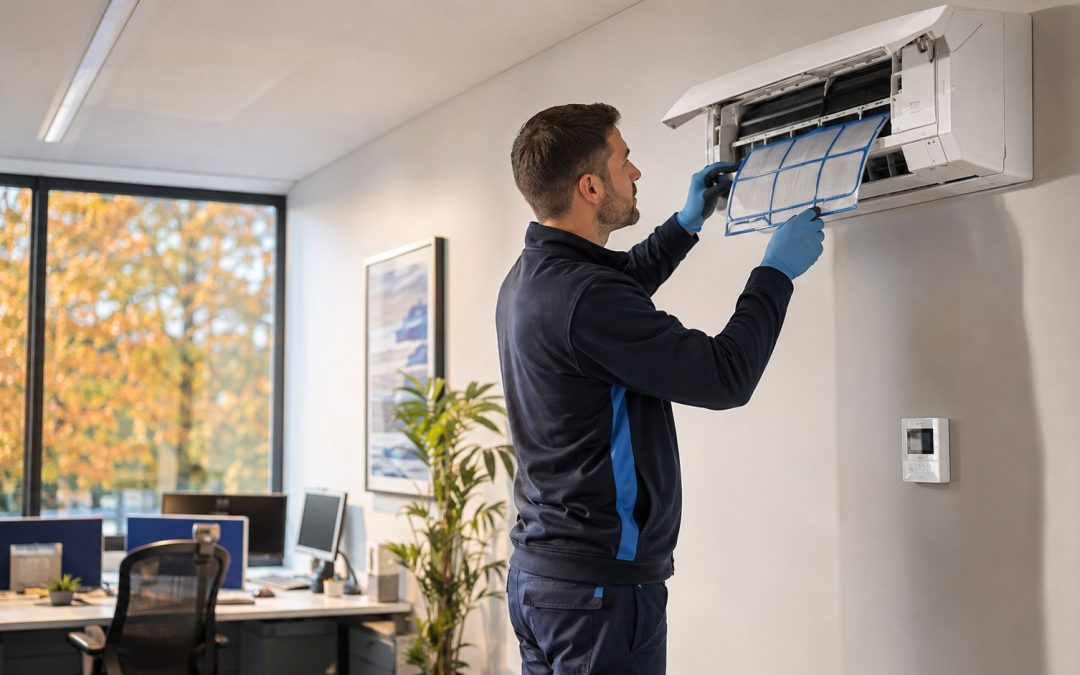
2. Check filters and visible airflow
Dirty filters restrict airflow and can reduce comfort. Facilities staff may be able to inspect or clean user-serviceable filters where the manufacturer’s instructions allow it and safe access is available. Do not remove fixed panels or access electrical and refrigerant components.
Look for weak airflow, uneven discharge, staining around grilles or dust returning quickly after cleaning. These can justify a deeper service of the heat exchanger, fan or ductwork.
3. Test heating mode before it is needed
Many modern comfort-cooling systems are reversible heat pumps. Select heating mode on a mild day, allow for the normal changeover delay, and confirm that each occupied zone responds. Make sure local controllers are not fighting a central schedule or building-management system.
During cold weather an outdoor unit can periodically defrost, and indoor airflow may pause. That is normal. Persistent cold air, repeated faults or failure to recover after defrost needs investigation.
4. Inspect condensate drainage
Cooling produces condensate, so summer operation is a useful stress test for drains and pumps. Check for historic water marks, odours, gurgling, intermittent pump noise and ceiling-tile staining. A partially blocked drain can remain unnoticed until it overflows.
An engineer can clean and test the drain route, pump, float switch and termination. Where a leak could damage stock, IT equipment or finishes, consider whether a high-level alarm or shut-down interlock is appropriate.
5. Look at outdoor units and access
From a safe position, check that outdoor units are not blocked by leaves, vegetation, stored goods or temporary screens. Air must be able to enter and leave the coil. Confirm that service access has not been lost to new fencing, roof works or storage.
Do not pressure-wash coils or remove guards. Bent fins, oil staining, corrosion, unusual vibration or damaged insulation should be recorded for professional inspection.
6. Check schedules, setpoints and responsibility
Overlapping time schedules and aggressive setpoints waste energy. Agree who controls temperatures, remove unnecessary overrides and set sensible operating hours. If heating and cooling systems serve the same area, check they cannot run against each other.
Label controllers clearly and keep a short user guide at reception or with the facilities team. Many ‘faults’ are mode or schedule problems that can be avoided with simple ownership.
7. Book planned maintenance around business risk
Service frequency should reflect the manufacturer, operating hours, environment, criticality and statutory requirements. A clean office used five days a week has different needs from a server room, commercial kitchen or dusty workshop.
A useful maintenance visit should leave you with findings, defects, priorities and asset records – not just a tick on a sheet. Aircon Services can plan visits around occupancy and business-critical areas across Oxfordshire, Buckinghamshire, London and nearby counties.
- Filters and heat exchangers checked and cleaned as appropriate
- Condensate drains and pumps tested
- Heating and cooling operation confirmed
- Controllers, schedules and sensors reviewed
- Outdoor units, pipe insulation and supports visually checked
- Faults, remedial work and replacement risks documented
Frequently asked questions
How often should commercial air conditioning be serviced?
It depends on use, environment, manufacturer guidance and system criticality. Many businesses plan at least annual maintenance, while server rooms, dusty premises or heavily used systems may need more frequent visits.
Can office air conditioning be used for heating?
Most modern split systems are reversible heat pumps and can heat as well as cool. The system design, controls and outdoor conditions determine performance.
Why does air conditioning smell when heating starts?
Dust on filters or heat exchangers, stagnant condensate or drain contamination can cause odours. Persistent smells should be investigated rather than masked.
Is a TM44 inspection the same as maintenance?
No. A statutory air-conditioning energy inspection and routine servicing have different purposes. One does not replace the other.
When should we replace commercial air conditioning?
Consider condition, reliability, parts availability, energy use, refrigerant, capacity and business disruption. A condition survey is better than relying on age alone.
If your systems have worked hard through summer, book an autumn air-conditioning maintenance visit before heating demand rises. Aircon Services will prioritise defects and plan any remedial work around your operation.
Call 0800 998 9135 or email enquiries@aircon-services.co.uk to book an autumn maintenance visit.