Why Does Your Office Feel Stuffy in Autumn? Air Conditioning vs Ventilation
The first cool weeks of autumn often bring the same complaint: the office feels warm, stale or difficult to concentrate in, even though the air-conditioning display shows a comfortable temperature. The timing is rarely a coincidence. Windows close, occupancy returns after summer holidays and ventilation schedules may no longer match how the building is used. Cooling the air and replacing it are different jobs. Understanding that distinction helps facilities managers investigate complaints without simply lowering the thermostat and increasing energy use.
Air conditioning and ventilation do different jobs
Air conditioning primarily controls temperature and, depending on the system, humidity. Many split and VRF indoor units recirculate room air: they cool or heat it, but do not automatically bring in outdoor air. Ventilation removes stale indoor air and supplies fresh outdoor air through windows, passive openings or a mechanical system. An office can therefore be cool but poorly ventilated, or well ventilated but uncomfortably warm. Some packaged systems combine the functions, but the installed design needs to be checked.
Why the problem becomes obvious in autumn
During summer, occupants may open windows and doors or spend more time away. As temperatures fall, openings stay shut to retain heat and avoid draughts. Meeting rooms fill again, and a ventilation system left on a reduced holiday schedule may not respond. Other common causes include clogged filters, closed or obstructed grilles, failed fans, disabled dampers and systems that start too late or stop before people leave. Changes to partitions and desk layouts can also leave occupied areas outside the original airflow pattern.
What employers need to provide
The Health and Safety Executive states that employers must ensure adequate ventilation in enclosed workplaces. The practical solution depends on room size, occupancy, activities and the existing building systems; there is no single thermostat adjustment that proves the duty is met. Start with occupancy patterns and how fresh air is actually delivered. If the answer is unclear, a ventilation survey is more useful than repeated comfort adjustments.
Use CO2 as a diagnostic clue, not a safety certificate
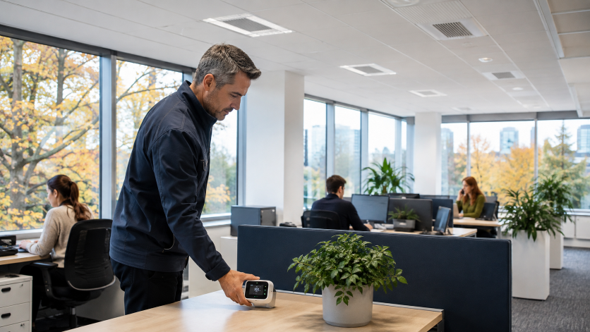
People exhale carbon dioxide, so CO2 readings can indicate how effectively occupied-space air is being diluted. HSE guidance notes that around 1,000 parts per million is broadly equivalent to 10 litres per second per person, while readings consistently above 1,500 ppm in an occupied room indicate poor ventilation and a need for action. CO2 is only a broad guide. It does not measure every contaminant and a low reading does not prove that the air is free of pollutants. Use a suitable monitor, place it away from windows, doors and an occupant’s direct breath, and look at patterns across normal occupied periods rather than one isolated number.
Checks to make before changing equipment
Compare time schedules with actual attendance. Check that supply and extract fans run, grilles are open and unobstructed, filters are within service life and meeting-room boost controls work. Review any recent layout changes and identify rooms where complaints coincide with high occupancy. Opening windows can help in suitable buildings, but it may introduce noise, security, pollen or energy problems and is not a complete strategy for every workplace. Mechanical ventilation should operate as designed before windows are treated as the permanent fix.
Improvements that can solve recurring stuffiness
The answer may be as simple as correcting a schedule or replacing filters. Other sites need fan repairs, damper recommissioning, occupancy-based control, better transfer-air routes or a redesigned system. Heat-recovery ventilation can help retain useful heat while introducing controlled fresh air. Aircon Services can assess ventilation and comfort cooling together, so changes improve indoor conditions without creating conflicting controls or avoidable energy waste.
Frequently asked questions
Does air conditioning bring in fresh air?
Many common split and VRF indoor units recirculate room air. Some systems include a fresh-air connection, but this must be confirmed from the design and installation.
What CO2 level means an office is poorly ventilated?
HSE says readings consistently above 1,500 ppm in an occupied room indicate poor ventilation and action should be taken. CO2 remains a broad indicator, not a complete air-quality test.
Why is the meeting room worse than the open office?
Meeting rooms often have high occupancy in a small volume and may lack working boost ventilation. Their schedule or design flow may not match current use.
Will lowering the air-conditioning temperature fix stuffiness?
It may make the room cooler, but it will not correct insufficient fresh-air supply where the air-conditioning system only recirculates air.
Next step
If complaints return as soon as the windows close, contact Aircon Services for a practical ventilation, controls and airflow survey.
Internal-link suggestions