
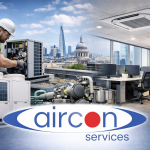
Commercial air conditioning systems are a critical part of modern buildings. Across offices, warehouses, healthcare environments and retail premises, HVAC systems directly influence occupant comfort, productivity, operational reliability and energy efficiency.
For businesses operating in Oxfordshire, Buckinghamshire and London, these systems must also meet increasingly strict compliance, sustainability and performance expectations. However, many commercial air conditioning systems that appear successful at handover begin to underperform within a few years.
At Aircon Services, we regularly encounter this issue when responding to breakdowns or assuming responsibility for maintaining existing systems. In most cases, the root cause is not the equipment itself, but a disconnect between design, installation and long-term maintenance planning.
The Importance of Proper System Design
Commercial HVAC problems frequently originate at the design stage. While these issues may not be immediately visible during commissioning, they often emerge during peak seasonal demand or later in the system lifecycle.
Common design-related challenges include:
– Outdoor units positioned with restricted airflow or poor service access
– Pipework routes selected for installation speed rather than longevity
– Limited allowance for future expansion or system modification
– Control strategies that do not reflect actual building occupancy or usage patterns
In dense urban environments such as London, and in constrained commercial sites across Buckinghamshire and Oxfordshire, thoughtful system design is essential to ensure reliability and compliance over the long term.
Installation Is More Than Equipment Placement
A commercial air conditioning system should be treated as a long-term asset, typically expected to perform reliably for 15 to 20 years. Installation quality plays a major role in achieving this lifespan.
Best-practice commercial installation includes:
– Correct pipe sizing for full-load and part-load operation
– Adequate support, protection and corrosion prevention
– Accessible valves, joints and critical components for future servicing
– Clear labelling, commissioning data and as-built documentation
These details are often unseen once a project is complete, but they directly influence maintenance efficiency, downtime and operating costs for building owners and facilities managers.
The Role of Planned Maintenance
Reactive maintenance is one of the most expensive ways to manage commercial HVAC systems. Planned preventative maintenance allows potential issues to be identified early, before they escalate into system failures.
Regular servicing helps to:
– Detect refrigerant losses before system capacity is affected
– Maintain airflow and heat exchange performance
– Preserve seasonal energy efficiency
– Extend the life of compressors, fan motors and electronic controls
For commercial properties across Oxfordshire, Buckinghamshire and London, planned maintenance also supports compliance with F-Gas regulations and health and safety obligations.
A Service-Led Commercial HVAC Approach
At Aircon Services, we believe commercial air conditioning should be engineered for real-world operation, not just for commissioning day.
We support clients across:
– Office buildings and corporate headquarters
– Warehouses and logistics facilities
– Healthcare and education environments
– Retail and mixed-use developments
Whether delivering new VRF installations, maintaining existing split and multi-split systems, or providing detailed fault diagnosis, our approach remains consistent:
Design for performance. Install for longevity. Maintain for reliability.
By integrating these principles from the outset, we help businesses across London, Oxfordshire and Buckinghamshire achieve dependable comfort, improved energy performance and long-term value from their commercial air conditioning systems.